Login
Login


There are approximately 40 species of birds of prey in Turkmenistan. The largest among them is the cinereous vulture. Its population in the wild is very small; consequently, it is listed in the Red List of the International Union for Conservation of Nature and the Red Book of Turkmenistan. This information was reported on the website of the Ministry of Environmental Protection of Turkmenistan.
When sitting, the bird stands over a meter tall; its wingspan reaches 3 meters, and it weighs 6–7,5 kg.
The feathers on this huge bird's tail and wings are black, while the rest of the body feathers are dark brown. The head and neck are also brown, but from a distance, the vulture appears black.
Every bird of prey living in the wild has a positive impact on the environment. Some predators hunt rodents, protecting trees and shrubs from pests; others prey on lame, sick, or injured animals; while still others—such as the cinereous vulture—feed on carrion, consuming the carcasses of animals that have died of natural causes.
In Turkmenistan, in addition to the Badhyz Nature Reserve, vultures are found in the Bolshoy Balkhan and Kopet Dag ranges, as well as in areas along the Amu Darya, Murghab, and other rivers.
In Badhyz, vultures lead a sedentary lifestyle. They build their nests in dense pistachio groves, on the ledges of steep cliffs in areas such as Kyzyljar and Yeroyulanduz, and in the hollows of black saxaul trees in the sandy lowland regions. Birds often choose nesting sites near bodies of water, where the entire area is clearly visible from the nest and the impact of air currents is minimal.
Vultures use the same nest for several years. As the nest becomes dilapidated and risks being blown away by strong winds, the birds build a new one.
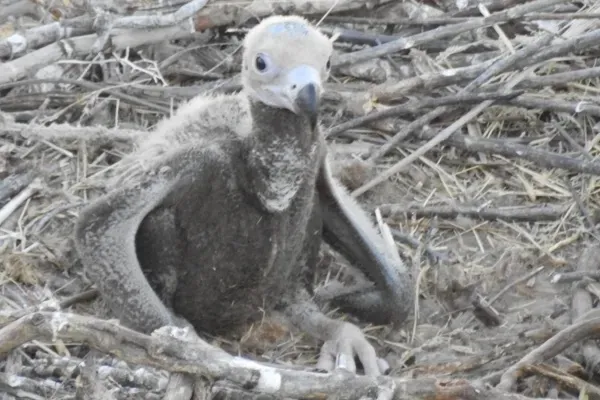
A pair of black vultures lays only a single egg, which is one of the reasons for the slow recovery of the natural population. The chicks hatch between mid- and late May. During the scorching heat of June and July, the adult birds sit over their chicks with their wings spread to provide shade and protect them from overheating. Both parents take part in caring for the offspring. As the chicks grow, their white down is replaced by true plumage. In August, they learn to fly and resemble a large hawk from a distance. This means that the new generation will soon join the adult flock.